

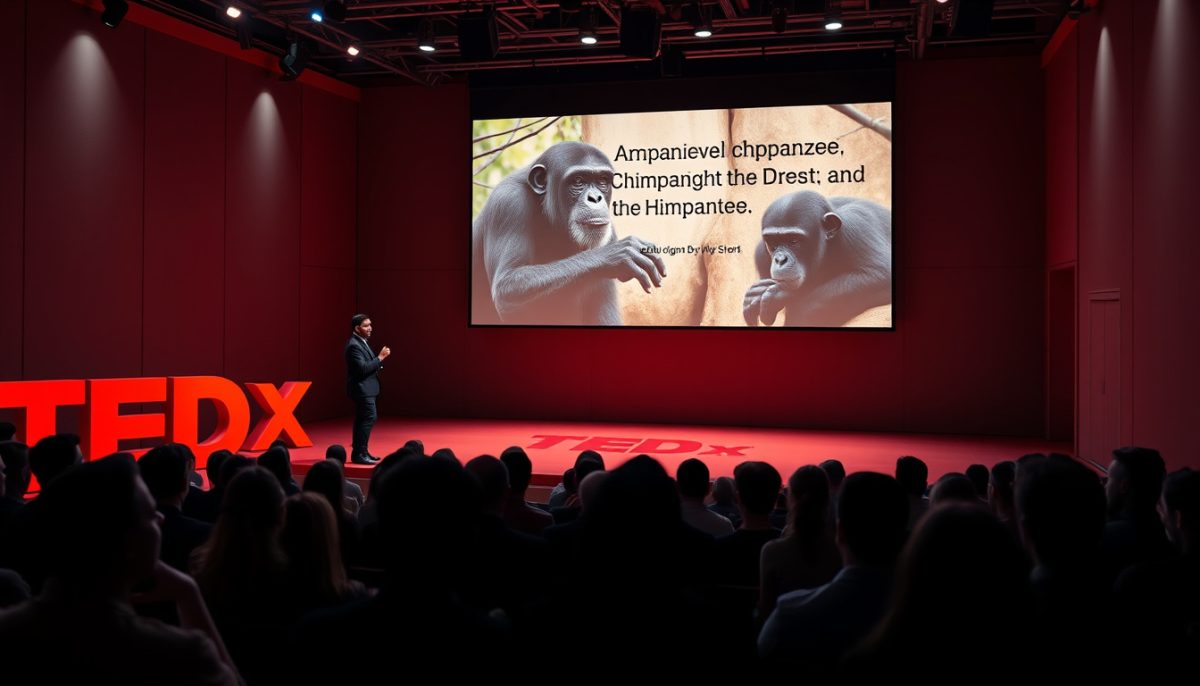
Unlocking the Secrets of Chimpanzees: Michael Wilson’s TEDxUMN Talk on Post-War Dream
For those familiar with the tense Cold War era, the constant threat of global annihilation was a daily reality. Michael Wilson’s engaging TEDx talk at the University of Minnesota doesn’t just revisit these daunting memories; it also connects them to profound insights into our nearest animal cousins—the chimpanzees. His research highlights the parallels between chimpanzee behavior and human conflict, offering unexpected perspectives on violence and peace that challenge our assumptions.
From Cold War Shadows to Primate Studies: Setting the Stage
Michael Wilson grew up during the height of the Cold War, a time rife with nuclear war fears. The culture of that era—through books, movies, and music like Pink Floyd’s The Final Cut—echoed a looming end-of-the-world scenario.
However, historical events such as the fall of the Berlin Wall and the Soviet Union’s dissolution turned despair into hope, showing conflicts could resolve without global ruin.
Wilson’s travels across the Soviet Union via the Trans-Siberian Railway to China and Japan revealed a fundamental similarity among people globally, prompting his inquiry into the deep divisions that drive human conflicts.
The Quest for Understanding: Why Study Chimpanzee Behavior?
Instead of studying human societies, Wilson’s conflict resolution interest led him to explore the social structures and behaviors of chimpanzees.
Triggered initially by Dian Fossey’s work with gorillas, the civil war in Rwanda redirected him to the chimpanzees of Uganda’s Kibale National Park.
Chimpanzees, although similar in appearance to gorillas, share a closer genetic bond with humans. This link offers crucial insights:
- Tool use: Chimps create tools like wands to retrieve termites, mirroring humans’ unique tool-making capabilities among primates.
- Group hunting: They display cooperative strategies in hunting, rare among non-human primates.
- Intergroup violence: Their group conflicts, often lethal, raise significant questions about the origins of human warfare and hostility.
The Imbalance-of-Power Hypothesis: Decoding Chimpanzee Conflict
Wilson’s research led him to the imbalance-of-power hypothesis. Picture two chimpanzee groups; one dominates due to superior resources, directly impacting survival and territorial conflict outcomes.
Chimpanzees in the dominant group capitalize on their numerical superiority to threaten or eliminate solitary members from smaller groups, eerily similar to human historical conflicts where power imbalances dictate conquests and defeats.
Testing the Theory: Field Experiments in Uganda
Wilson’s rigorous fieldwork in Uganda illuminated how chimpanzees evaluate threats based on their group’s size. This strategic assessment mirrors how humans manage risks in confrontations.
- Playback experiments: Wilson used audios of chimpanzee calls to test group reactions based on their strength, revealing that larger groups responded more aggressively.
- He also analyzed numerous instances of chimpanzee conflicts, finding a consistent pattern of attackers outnumbering their victims significantly, reinforcing the importance of numerical advantage in conflicts.
Reflecting on Primate Aggression: Insights into Violence and Peace
The observable behaviors in chimpanzees provide a stark reflection of human societal conflicts, where coalitional aggression plays a pivotal role.
This comparative analysis offers two key insights:
- Violence as a Strategy Within Complex Social Systems
The dynamic nature of chimpanzee societies, continuously adapting to ecological shifts, enlightens our understanding of human warfare’s complexity. - Hope Anchored in Shared Biology and Experience
Despite the ingrained behavioral tendencies towards conflict seen in chimpanzees, Wilson’s journey underscores the human potential for peace, highlighted by the peaceful resolution of the Cold War.
Conclusion: Lessons from Chimpanzee Behavior and the Post-War Dream
Michael Wilson’s TEDxUMN talk weaves a compelling narrative from global human fears to primal primate behaviors, emphasizing that while conflict is part of our shared evolutionary legacy, it doesn’t have to define our future. The lessons drawn from chimpanzee behavior enlighten us about our capacity for peace and cooperation, echoing the promising hopes of a post-war dream once overshadowed by nuclear threats.
Keywords:
Chimpanzee behavior, imbalance-of-power hypothesis, Cold War, chimpanzee violence, primate social structure, coalition aggression, TEDxUMN, Michael Wilson, chimpanzee tool use, fission-fusion society, human conflict origins, chimpanzee killings, chimpanzee playback experiments, post-war dream.
If this story sparked your curiosity, you can experience it firsthand.
Bushman Safaris offers curated chimpanzee tracking experiences in Uganda, including access to Kibale National Park and the Ngogo region where these remarkable behaviors have been observed.
For our top 3 recommended Uganda chimpanzee tours, simply text “chimpanzee” to info@bushmansafaris.com
or WhatsApp +256 704 902398, and we’ll send you tailored options based on your travel preferences.