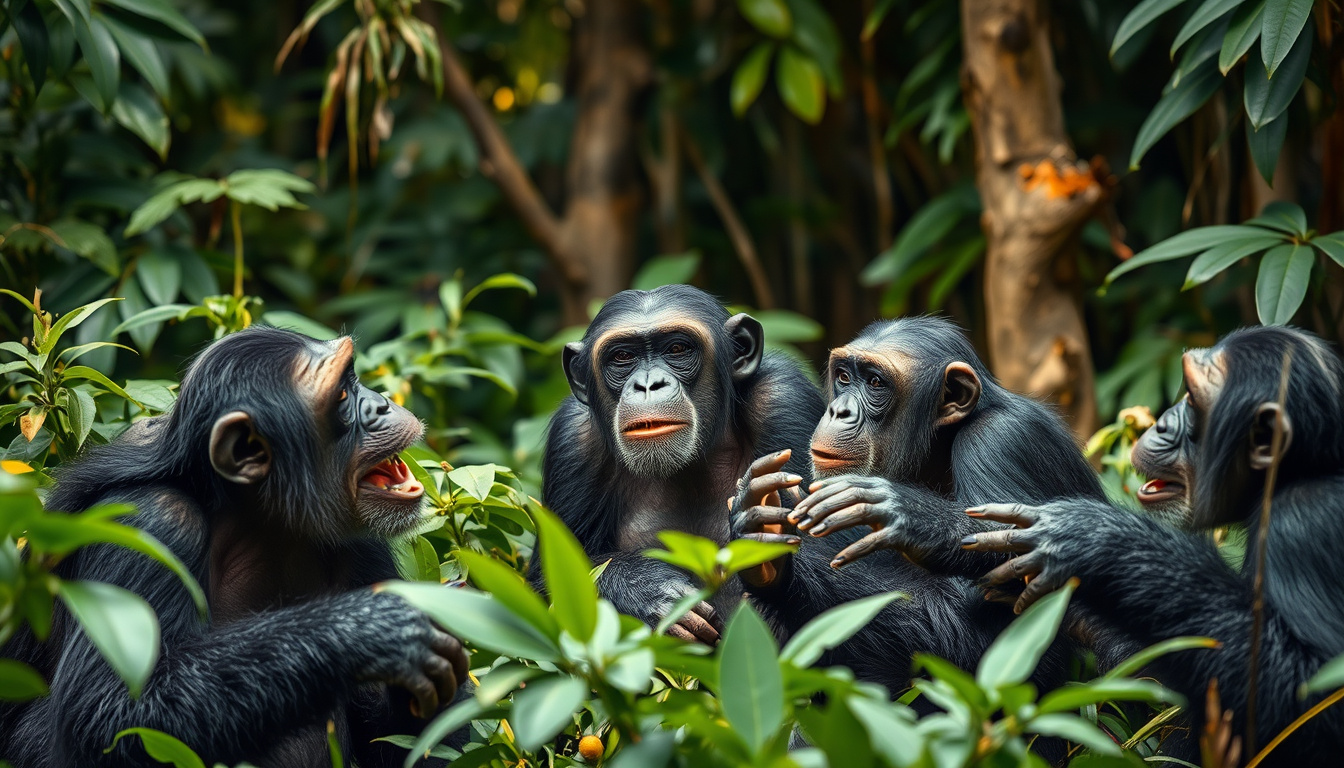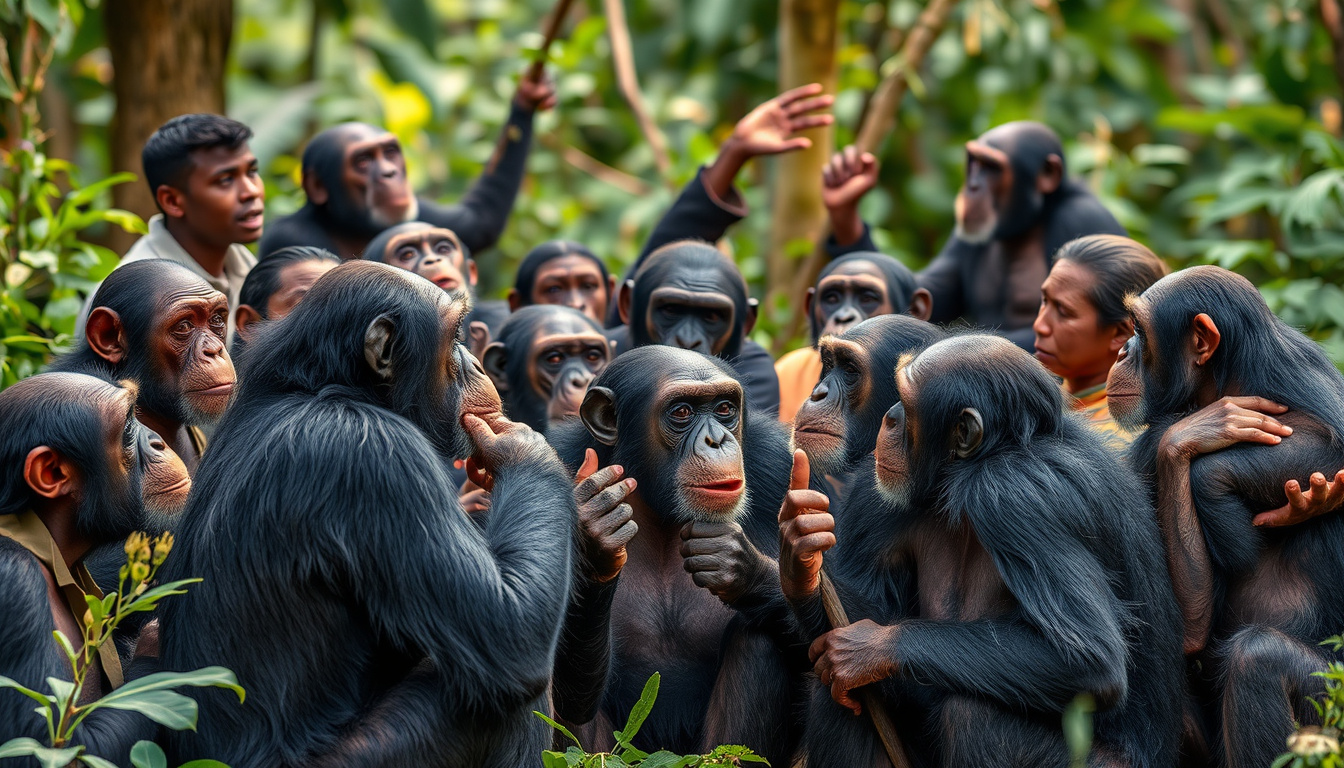

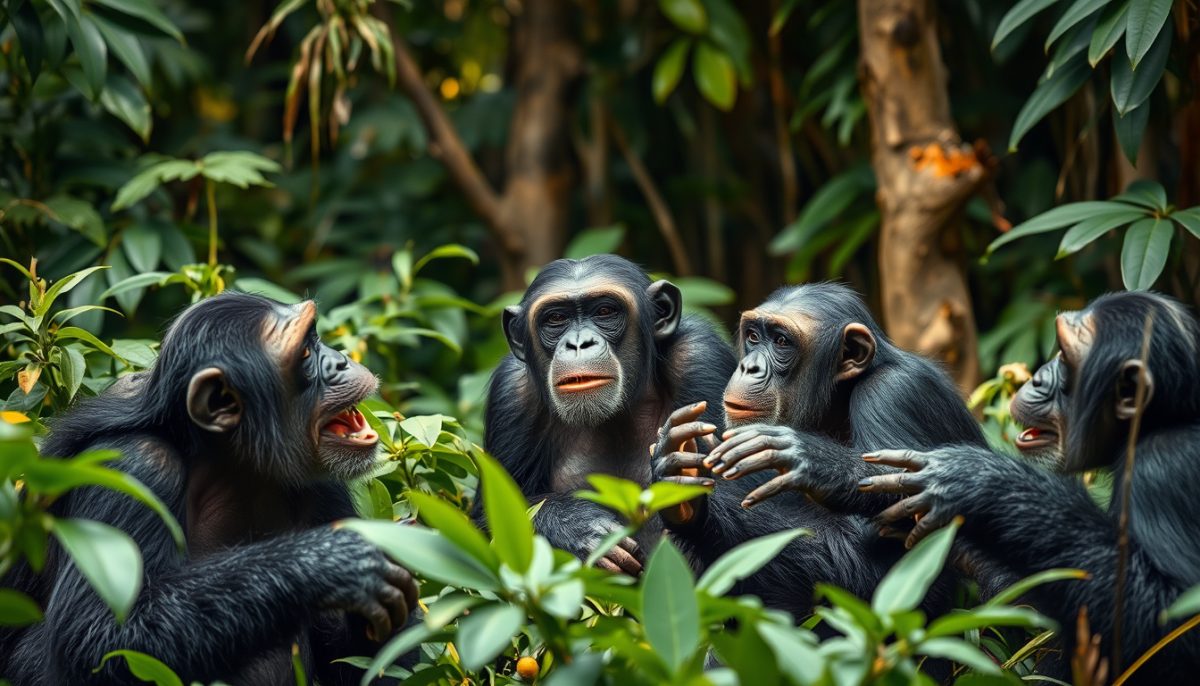
In the depths of Uganda’s verdant forests, where the cacophony of nature meets an orchestra of dynamic sounds, the intricate world of chimpanzee communication behavior unfurls like a captivating tale.
These intelligent primates, sharing over 98% of our DNA, possess an extraordinary system of communication that weaves together vocalizations, gestures, and social nuances.
Witnessing this complex interplay offers not just a glimpse into their lives but reveals profound insights into our own evolution.
Ready to embark on a journey into their secret language?
Let’s delve deeper into the fascinating realm of chimpanzee communication and discover what these remarkable creatures are really trying to tell us.


Non-verbal Communication: Gestures and Body Language
Chimpanzee communication behavior is a captivating area of study, revealing the intricate ways these primates interact without vocal sounds.
Non-verbal communication plays a pivotal role in their social structures, often influencing group dynamics and individual relationships.
Through various gestures, postures, and body movements, chimpanzees convey emotions ranging from excitement to aggression.
For instance, a raised arm can signal an alertness to danger, while a gentle touch or grooming can express affection and strengthen bonds.
Understanding these subtle yet powerful signals enriches our knowledge of their complex social lives, drawing fascinating parallels to human non-verbal communication.
As we observe these behaviors in their natural habitat in Uganda, we gain deeper insights into the evolution of communication, revealing a rich tapestry of interaction that goes beyond mere sound.
The Influence of Social Structure on Communication Behavior
# Chimpanzee Communication Behavior: A Closer Look at the Influence of Social Structure
Imagine standing in the dense jungles of Uganda, enveloped by the sounds of leaves rustling and the distant calls of wildlife.
Suddenly, a chorus of whoops and hoots fills the air, signaling that you are not just an observer but a part of a vibrant social network communicating in ways that echo their shared experiences and hierarchies.
Understanding chimpanzee communication behavior goes beyond mere sounds; it’s a window into their intricate social lives and the bonds that tie them together in the wilderness.
## Overview
Chimpanzees, one of our closest relatives, exhibit remarkable communication behaviors that reflect their complex societies.
Living in tightly knit groups, or communities, these intelligent primates rely on vocalizations, gestures, facial expressions, and body language to convey messages and reinforce social bonds.
Their communication style is richly layered, influenced significantly by their social structure, which plays a critical role in how they interact with one another, develop relationships, and navigate their environment.
## Deep Dive into Chimpanzee Communication Behavior
Chimpanzee communication behavior encompasses a range of sounds—pant-hoots, screams, grunts, and barks—each carrying its unique meaning.
For instance, a pant-hoot, typically performed by a dominant male, can serve multiple purposes: it may signal his presence, assert dominance, or even recruit allies during foraging activities.
The nuances of vocal communication are shaped by social hierarchies.
Higher-ranking individuals often have a broader array of vocalizations, potentially indicating their status in the group.
Meanwhile, lower-ranking chimpanzees may use softer calls, reflecting their uncertain position.
Their communication also incorporates non-verbal cues; for example, a gentle grooming session can serve as a powerful form of non-verbal interaction, expressing trust and camaraderie among individuals.
Moreover, chimpanzees are known to use the presence of other group members to modify their communication.
They adjust their vocalizations based on the listeners’ identities, showcasing a level of cognitive sophistication that resembles human conversational rules.
Interestingly, this ability to alter communication based on social context not only underlines their adaptability but also demonstrates the essential role social structure plays in shaping behavior across the group.
## Key Insights
The comparison between human and chimpanzee communication reveals fascinating parallels in how social structures influence interaction dynamics.
Just as humans adjust their tone of voice, language, and non-verbal cues depending on context or the audience, chimpanzees modify their vocalizations according to the individuals present.
This adaptation hints at a shared evolutionary trait rooted in the need for effective communication within social groups.
Interestingly, studies suggest that chimpanzees can perceive emotions in the calls of their peers, indicating a level of emotional intelligence.
They may respond differently to distress calls based on their relationship to the caller, a mechanism that serves to strengthen social bonds and cohesion.
This profound understanding of social dynamics hints at the evolutionary advantages of being attuned to both vocal and non-verbal communication cues, traits that are vital for group cohesion and survival.
## Connecting to Real-World Experiences
Want to experience this in the wild?
You can request our top chimpanzee tracking experiences in Uganda by messaging ‘chimpanzee’ to info@bushmansafaris.com or +256 704
902398.
Imagine being in the lush forests of Kibale National Park or the dense canopies of Bwindi Impenetrable National Park, where you can observe chimpanzees in their natural habitat, engaged in vibrant social interactions.
Witnessing their communication behaviors firsthand is not only an educational experience but also a deeply emotional one, connecting you with the primal roots of sociality shared by all great apes.
## Conclusion
Chimpanzee communication behavior is a fascinating interplay of sound, emotion, and social structure, revealing how intricately connected these animals are to one another.
As researchers continue to study the dynamics of their social interactions, there is much to learn about the evolution of communication itself.
The experience of watching chimpanzees in Uganda provides invaluable insights not only into their lives but also into our connections as humans.
As you reflect on this, consider how your own social structures influence your communication, and how observing these magnificent creatures could enrich your understanding of our shared evolutionary heritage.
To dive deeper into these captivating experiences, request the top 3 curated Uganda chimpanzee tours by texting ‘chimpanzee’ to info@bushmansafaris.com or +256 704 902398 (WhatsApp).
Be prepared to embark on a journey that offers not just beautiful landscapes but also a profound appreciation for the social complexities of our closest relatives.

Research Methodologies in Studying Chimpanzee Communication
# Research Methodologies in Studying Chimpanzee Communication Behavior
Chimpanzees, our closest relatives in the animal kingdom, exhibit a striking range of communication behaviors that offer immense opportunities for study.
To understand these behaviors fully, researchers employ a variety of methodologies that span observational techniques, experimental setups, and theoretical frameworks.
One primary method involves long-term field studies, where researchers immerse themselves in the common habitats of chimpanzees, such as Uganda’s lush forests.
By observing chimpanzee communication behavior in their natural environment, scientists can capture the nuances of vocalizations, gestures, and postures without disrupting their natural social interactions.
Additionally, innovative technologies like audio and video recording devices enable thorough documentation of chimpanzee interactions, allowing for subsequent analysis of communication patterns.
Moreover, experimental methodologies can isolate specific variables affecting communication.
For example, researchers might introduce a food reward to see how that impacts the vocalizations and interactions among a group of chimpanzees.
Ethograms—a detailed catalog of behaviors—are often developed to categorize different communication methods and understand their functions within various social contexts.
Psycholinguistic approaches also lend insights into chimpanzee communication, exploring cognition and the underlying mechanisms of language-like behaviors.
By comparing chimpanzee communication behavior to human linguistic traits, researchers delve into questions about the evolution of language and our shared ancestry.
These multidisciplinary methods provide a comprehensive understanding of how chimpanzees communicate, enriching our insight into their social structures, emotions, and cognitive abilities.
Implications of Understanding Chimpanzee Communication for Conservation and Human Interaction
## Implications of Understanding Chimpanzee Communication Behavior for Conservation and Human Interaction
As we delve into the fascinating world of chimpanzee communication behavior, the implications reach far beyond mere observation.
Understanding how these remarkable primates interact can illuminate our own human social structures and communications.
Chimpanzees possess a complex system of gestures, vocalizations, and facial expressions that are not only vital for their social cohesion but also crucial for conservation efforts.
By studying their communication patterns, researchers can gain insights into the cognitive capacities of chimpanzees, further underscoring the ethical responsibilities humans have towards their conservation.
Effective communication in chimpanzees aids their foraging, mating, and conflict resolution, providing clear indicators of their well-being and environmental health.
This understanding serves as a pivotal tool in conservation biology.
For instance, knowledge of how chimpanzees communicate can guide the development of habitat management strategies that respect their social structures and behavior.
This is especially critical in regions like Uganda, where chimpanzees face threats from deforestation and poaching.
By fostering environments that allow for natural communication, we not only benefit chimpanzees but also enhance biodiversity and ecosystem stability.
Moreover, chimpanzee communication behavior opens avenues for enriching human-chimpanzee interactions.
The more we comprehend their emotions and intentions, the better equipped we are to engage with them in sanctuaries and during tracking sessions in the wild.
Such experiences can deepen our appreciation for these creatures, highlight the importance of conservation, and even foster a sense of stewardship among visitors.
For those looking to immerse in such meaningful experiences, exploring Uganda’s forests and observing these whimsical beings in their natural habitat can be a transformative journey.
Want to experience this in the wild?
You can request our top chimpanzee tracking experiences in Uganda by messaging “chimpanzee” to info@bushmansafaris.com or +256 704
902398.
Frequently Asked Questions
What are some key vocalizations used in chimpanzee communication?
Chimpanzees use a variety of vocalizations, including hoots, screams, grunts, and pant-hoots, each serving different social functions like alerting others or expressing emotions.
How do chimpanzees use gestures in their communication?
Chimpanzees frequently use gestures such as arm raises, pointings, and hand claps to convey messages to each other, showcasing their complex understanding of non-verbal cues.
In what ways does social structure affect chimpanzee communication behavior?
Social hierarchy, relationships, and group cohesion influence how chimpanzees communicate, as dominant individuals may exhibit different vocalizations and gestures compared to subordinates or infants.
What are some research methodologies used to study chimpanzee communication?
Researchers utilize a variety of methods, including observational studies in natural settings, controlled experiments, and recording technology to analyze vocalizations and gestures in chimpanzee behavior.
Why is understanding chimpanzee communication behavior important for conservation efforts?
Understanding chimpanzee communication can enhance conservation strategies by improving human-chimpanzee interactions, informing habitat protection initiatives, and fostering species awareness among local communities.
If this story sparked your curiosity, you can experience it firsthand.
Bushman Safaris offers curated chimpanzee tracking experiences in Uganda, including access to Kibale National Park and the Ngogo region where these remarkable behaviors have been observed.
For our top 3 recommended Uganda chimpanzee tours, simply text “chimpanzee” to info@bushmansafaris.com
or WhatsApp +256 704 902398, and we’ll send you tailored options based on your travel preferences.