

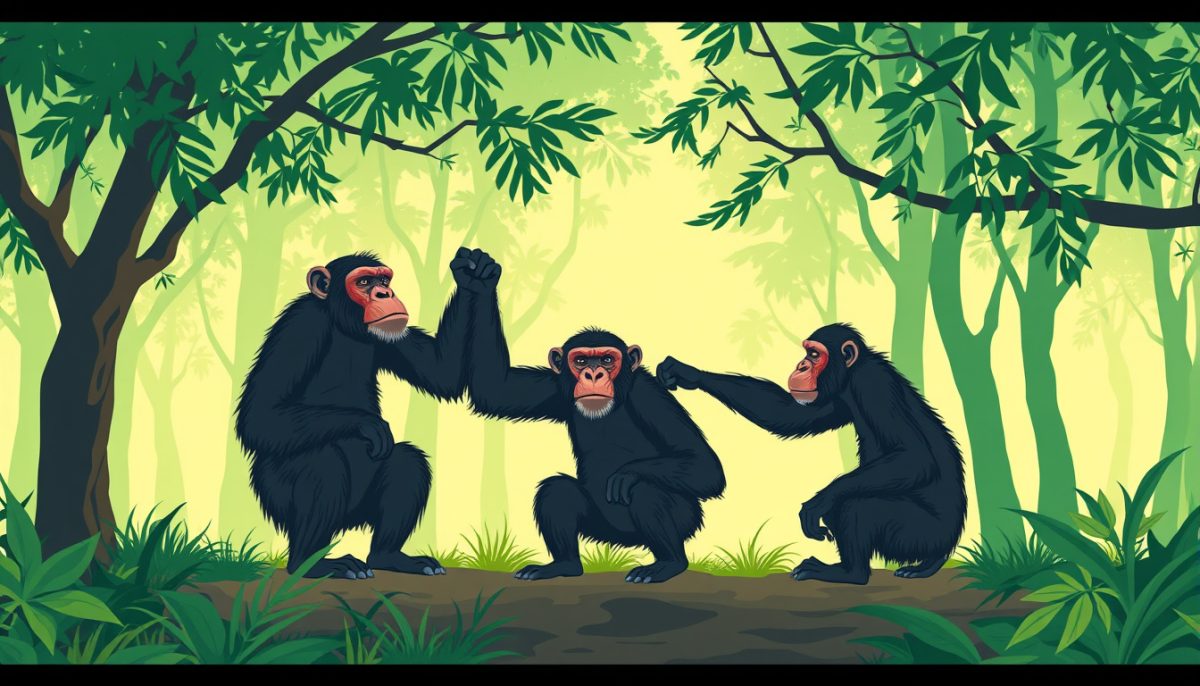
Inside the Gombe Chimpanzee War: Unveiling the Chimp Civil War of 1974-1978
The lush terrain of Tanzania’s Gombe Stream National Park paints a picturesque scene—dense forests rising through steep valleys to meet the clear waters of Lake Tanganyika. Embedded in this stunning landscape, the Gombe Chimpanzee War unfolded in the 1970s, showcasing the brutal and political nature of chimpanzees. Welcome to this intense, four-year saga of alliances, betrayal, and survival among the jungle canopy.
Overview of the Gombe Chimpanzee War
Between 1974 and 1978, two factions of chimpanzees in Gombe Stream National Park clashed fiercely in what is now known as the Gombe Chimpanzee War. The Kasakela community and their rivals, the breakaway Kahama tribe, engaged in a conflict driven by power struggles and strategic hunting, observed closely by primatologist Jane Goodall.
The challenging terrain of Gombe National Park allowed for the detailed observation of these unique animal behaviors, providing crucial insights into chimpanzee society.
Prelude to the War: A Community Divided
In the 1960s, Jane Goodall’s pioneering research in Gombe challenged the then-popular view of chimpanzees as gentle and playful, revealing their capacity for political strategy and violence. Her observations uncovered a complex social structure among the chimpanzees.
By the end of the 1970s, the Kasakela tribe exhibited unity under an alpha male named Leakey. After Leakey’s death created a power vacuum, Humphrey took over, facing immediate challenges from two ambitious brothers, Charlie and Hugh. Their dissent led to the formation of the Kahama tribe, marking the start of severe internal strife.
The divisions within the Kasakela community deepened, with Humphrey and his allies controlling the northern territory, while Charlie and Hugh moved south with their followers, setting the stage for the impending conflict.
The Spark: The Onset of War
The violence began suddenly in January 1974 when six Kasakela males formed a war party and attacked Godi, a member of the Kahama faction. This initial, brutal assault set the tone for the war, highlighted by a savagely violent but strategic approach to combat.
Godi’s severe beating and subsequent disappearance were a grim indicator of the war’s nature, contrasted starkly by the Kasakela’s celebratory behaviors after the attack.
The War Unfolds: Strategy and Sorrow
Over the next four years, the Kasakela frequently targeted isolated Kahama males during feeding times, a tactic noted by Jane Goodall for its ruthless efficiency. Members of the Kahama tribe, including prominent figures like De and Goliath, were systematically eliminated.
After decimating the male Kahama members, the Kasakela shifted focus to the females—some resisted and were killed; others were forcibly integrated into Kasakela society, marking Kahama’s complete absorption by early 1978.
Deeper Understanding: Lessons from the Gombe Chimpanzee War
The documented warfare not only expanded our view of chimpanzee behavior but also brought insights into their complex social structures, comparable in some ways to human political activities.
These observations prompted a reevaluation of alpha leadership dynamics and underscored the strategic, coordinated nature of chimpanzee conflicts, reflecting deep evolutionary roots shared with humans.
Beyond the Battle: Implications of Chimpanzee Warfare
The Gombe Chimpanzee War offers profound insights into the bases of social conflict, tracing evolutionary parallels across species. It shows how deeply ingrained the impulses for territorial dominance and social stratification are within primates.
The conflict further challenges our understanding of the natural world, revealing intricate social dynamics that bridge the divide between human and animal behaviors.
Conclusion: Reflecting on the Gombe Chimpanzee War’s Legacy
The end of the Gombe Chimpanzee War did not signify peace but rather a continuation of power struggles, a persistent theme in the natural order. Jane Goodall’s detailed records provide invaluable insights into the political nature of chimpanzees, offering lessons that resonate far beyond Gombe’s forests.
This intense conflict not only highlights survival tactics but also invites us to reconsider the nature of violence and alliances in the wild, deepening our understanding of both animal and human societies.
References & Further Reading:
Delve deeper into this topic by exploring Jane Goodall’s digitized field notes from the Gombe studies.
Explore the intersections of human and animal narratives within the vibrant tableau of nature’s ongoing dramas.
Curious to see similar behaviors in the wild? Bushman Safaris offers tailored chimpanzee tracking tours in Uganda. Discover more by contacting us via email at info@bushmansafaris.com or WhatsApp at +256 704 902398.