

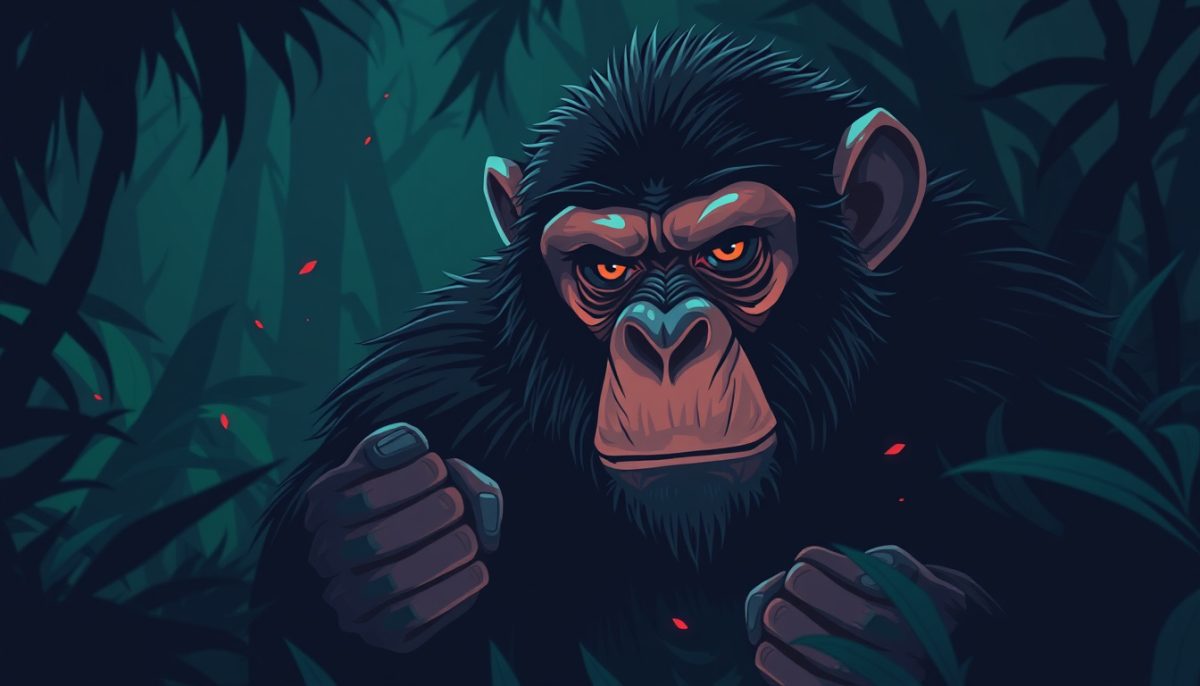
The Shocking Truth: Unveiling the Intimidating Nature of Chimpanzee Behavior
When you envision a chimpanzee, what comes to mind? Maybe a playful, curious creature with mischievous eyes, tumbling through trees or clowning around in viral videos. We’ve seen them wearing clothes in commercials, and even riding tricycles in zoos. They appear almost childlike, their expressive faces so familiar, making it easy to view them as gentle cousins of humanity. However, this perception is profoundly misleading. The truth about chimpanzees, key to understanding chimpanzee behavior, reveals a far more complex and unsettling reality. These animals, shaped by evolution, are highly aggressive, strategic, and formidable competitors.
What Is a Chimpanzee? Context and Habitat
Chimpanzees, sharing approximately 98.7% of our DNA, are one of humanity’s closest living relatives. They inhabit the tropical forests of Central and West Africa, environments that are anything but tranquil. These forests are dense, resources are scarce, and survival depends heavily on competition for food, territory, and mates.
Typically, chimpanzee communities consist of 15 to 80 individuals, each controlling a defined home range essential for their survival—food, water, and hunting grounds. Losing territory can mean losing access to vital resources, and consequently, death. In these fiercely competitive settings, chimpanzees evolved not for peace, but to outsmart, outfight, and outlast any rival, which is crucial for understanding their behavior.
The Evolution of a Fierce Competitor: Strength and Strategy
While they may look smaller and less imposing, chimpanzees possess a surprising amount of strength. An adult male typically stands about 1.2 meters tall and weighs between 40 and 60 kilograms. Compared to humans, their physical capabilities are extraordinary.
Studies show that chimpanzees outperform adult human males in pulling strength by two to five times. This isn’t just because they have larger muscles, but their muscles are rich in fast-twitch fibers, enabling explosive power and maximal force. Chimpanzees are naturally built for confrontation. Their instinct and every muscle movement are optimized for speed, power, and aggression.
Their hands function like weapons—capable of hanging their entire body weight from a single arm and exerting strong grip strength to bend or tear objects with ease. Their long, sharp canines are designed not merely for defense but for strategic biting. Unlike a cornered animal, chimpanzees attack with precision, aiming for vulnerable areas to maximize damage.
Real-World Horrors: The 2009 Stamford Attack
The terrifying potential of chimpanzee aggression was spotlighted on February 16, 2009, in Stamford, Connecticut. Travis, a 90-kilogram chimpanzee domestically raised for 14 years, tragically attacked Charla Nash, a friend of his owner. The emergency scene revealed brutal, precisely inflicted injuries that required Charla to undergo a full face transplant, highlighting a calculated, almost human-like violence in chimpanzee behavior.
The deliberate nature of Travis’s attack resembles those observed in wild chimpanzee conflicts, where vulnerable body parts are targeted methodically.
The Methodical Nature of Chimpanzee Violence
This pattern of targeting specific regions like the face, hands, and feet is documented globally, whether in animal sanctuaries, research stations, or settlements in Africa. The injuries are neither random nor merely instinctive; they show a force driven by an intelligent, purposeful kind of violence.
Chimpanzees are cognitively advanced hunters who engage in coordinated territorial wars, execute premeditated assaults on rival males, and use strategic planning to dominate. This formidable intellect makes their aggressive behavior particularly daunting.
Tool Use and Tactical Hunting
Before Jane Goodall’s studies in the 1960s and ’70s, advanced tool use was considered a uniquely human trait. Goodall’s work with chimpanzees, which demonstrated their ability to choose and modify tools for specific tasks, shattered this notion. They craft spears to hunt and teach their young to use tools, showcasing a sophisticated behavioral complexity.
Two Original Insights: What Chimpanzee Behavior Reveals About Us
Firstly, the misconception that chimpanzees are gentle reflects our tendency for human anthropomorphism—assigning human-like qualities to animals. Secondly, the blend of intelligence and physical power in chimpanzees leads to strategic aggression, echoing ancient survival tools that we must recognize in ourselves as well.
Conclusion: Reframing Our Relationship with Chimpanzees
Chimpanzees are far from the comical creatures often portrayed in popular culture. They embody a complex mix of competition, strategy, and sometimes violent behavior, fine-tuned by millions of years of evolution. Understanding them as our closest relatives requires respecting their profound capabilities and rethinking the simplistic views often held about animal intelligence.
Keep these truths in mind next time you encounter a chimpanzee. Beneath that familiar face lies a creature evolved for survival—fiercely, strategically, and sometimes, terrifyingly. Understanding the full scope of chimpanzee behavior compels us to appreciate the intricate complexity of the natural world.
Keywords: chimpanzees, chimpanzee attacks, chimpanzee strength, primate aggression, chimpanzee intelligence, wild chimpanzees, chimpanzee behavior, chimpanzee tool use, animal violence, Travis chimpanzee attack
If this story sparked your curiosity, experience it firsthand.
Bushman Safaris offers curated chimpanzee tracking experiences in Uganda, including access to Kibale National Park and the Ngogo region where these remarkable behaviors have been observed.
For our top 3 recommended Uganda chimpanzee tours, simply text “chimpanzee” to info@bushmansafaris.com
or WhatsApp +256 704 902398, and we’ll send you tailored options based on your travel preferences.