
The Dramatic Chimpanzee Civil War and Empire’s Fall in Uganda’s Enggo Region
In the deep rainforests of Uganda, a truly uncommon occurrence has been capturing the attention of nature observers for years: a bloody civil war among chimpanzees. This real-life story, reminiscent of Hollywood’s fictional narratives, entirely overturns our common associations of peace and friendship within the chimpanzee community. The dissolution of family ties, siblings turning against each other, and a ferocious struggle for power…Translated from English to Turkish, this documentary reveals the complex social structures inherent in primate communities and how these structures can lead to their undoing.
Kibale National Park and the Ngogo Area: The Chimpanzee Empire’s Capital
The tragedy begins in Uganda’s Kibale National Park. Covering an area of 795 square kilometers, this park represents a kingdom for primates. It is particularly noted for its substantial chimpanzee population, often referred to as the “primate capital.”
Located within the park, the Ngogo area is a phenomenon in itself. In this region, where food resources are abundant, a massive chimpanzee group of over 100 individuals has developed, three times the size of other chimpanzee groups. Normally consisting of 30-40 members, the oversized groups drastically alter social dynamics and behavioral patterns.
The Rise of the Empire: Alpha Jackson’s Leadership
Thanks to a research station established in 1995, scientists discovered that the Ngogo chimpanzee community had evolved into a state-like structure. Dominating an area of 29 km², this community uses its numerical superiority not just for hunting or daily needs but for political dominance as well.
Often compared to Sultan Mehmet for his leadership style, Alpha Jackson spearheads this vast community. Under Jackson’s leadership, the Ngogo chimpanzees have repeatedly raided neighboring groups’ territories, ambushing and incapacitating rival group members. These are not merely routine attacks but well-planned, organized, and multifaceted warfare tactics.
After these wars, over ten years, territories in the northeast were seized, and the Ngogo chimpanzee empire grew significantly in both population and land area. The secured territories now approximate the size of Turkey’s Bozcaada, with fertility rates rising by 146% due to the abundance of food while infant mortality rates dropped by 80%.
Why Do They Fight? The Chilling Reality of Nature
So, why do chimpanzees engage in civil wars akin to humans? Observations from Ngogo show that this is not just about resource sharing. By conquering land and increasing food sources, these groups aim to create less competition and lower the risk of death within their own communities.
As a result of these wars, cooperation with rival groups ceased, subsequently providing a safer environment for their young and other community members. Essentially, the primary motive for conflict is survival and the guarantee of transmitting genes to better future generations.
The End of an Empire: The Cracked Giant
The Ngogo empire, led by Alpha Jackson, continued to strengthen for 20 years but began showing signs of collapse in 2015. The chimpanzee population surpassing 200 complicated organizational efforts. Moreover, a respiratory infection spreading through the area caused many deaths, signaling the beginning of a devastating epidemic.
This loss led to the death of seasoned leaders who kept the community together, causing the group to divide into Western and Central factions. Eventually, the former allies became dominated by fear and aggression; the chimpanzees, once walking side by side and raising their children together, now treated each other as strangers and enemies.
The Beginning of the Civil War and a Bloody Struggle
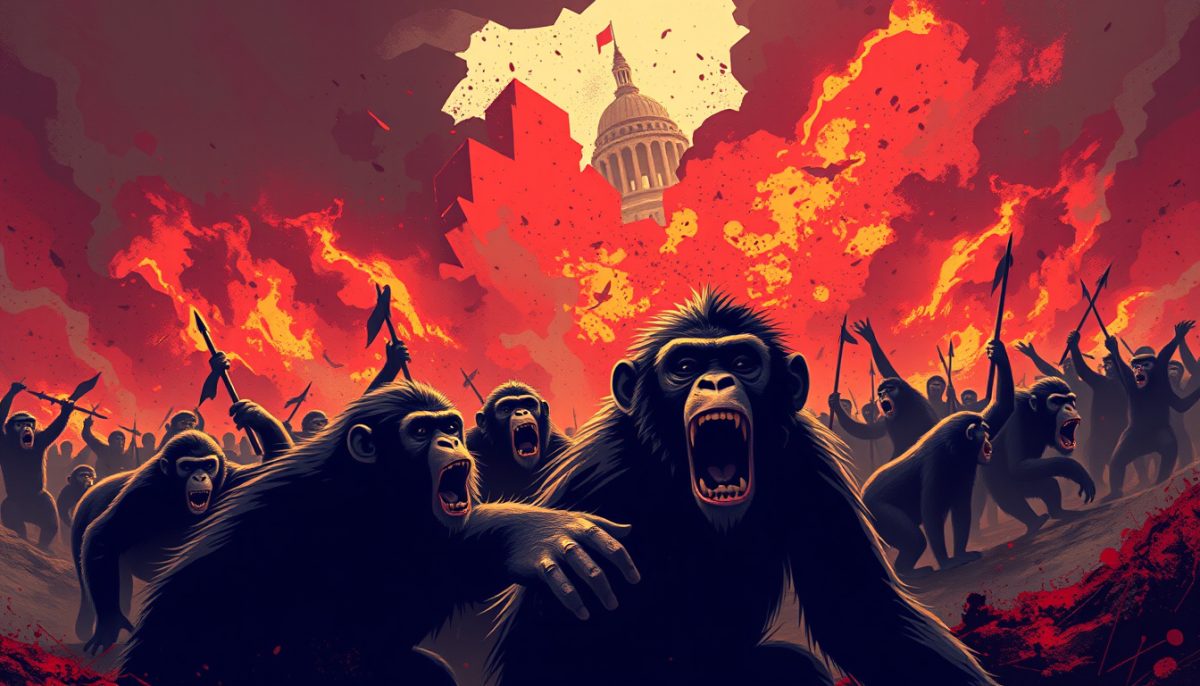
In the following years, patrolling movements between the Western and Central groups began. In 2018, Western alpha Hatcherson raised the flag of rebellion, initiating a violent war. The numerically superior Central group faced fierce and lethal raids by the West, employing cunning and aggressive tactics.
In this war, the Western group killed at least 7 adult males and 17 babies. The attacks, particularly targeting the young, aimed to suppress the Central group’s reproductive capacity. Many healthy male chimpanzees also disappeared after being ambushed.
Harrowing War Tactics and Their Meaning
Researchers’ reports indicate that this war was conducted not only for territory and resources but also with brutal psychological tactics. The victorious Western group would drink the blood of their defeated enemies, sever limbs, and mercilessly slaughter former friends.
This extreme violence underscores how the breakdown of social bonds and the perception of “the other” can have devastating outcomes in both human and animal realms.
Humans and Animals: Are We Really So Different?
The bloody internal conflict among chimpanzees sheds light on the nature of human civil wars. While we often interpret violence through ideologies, religions, and nationalism, chimpanzees, devoid of any ideology or culture, enter into systematic conflicts after years of friendly relations—a stark reminder that warfare and violence likely stem from fundamental, primitive motivations.
Perhaps what binds humanity together isn’t conscience but the presence of necessary resources. As scarcity or power balances shift, both humans and animals reveal the horrific face of violence.
Conclusion: The Ruins of Ngogo and a Mirror to Humanity
The civil war in Uganda’s forests, particularly within the Ngogo chimpanzee community, is not just significant for natural history but also poses essential questions about human nature, our social structures, and the origins of violence. As we ponder, are we really that different from them?
In times when natural resources become scarce or power dynamics shift, nature might be screaming harsh truths at us. If internal conflicts, friction, and divisions are occurring in distant monkey communities, the dark aspects of human societies grappling with social and political crises could be much more comprehensible.
The dramatic story of the Ngogo Empire serves as a powerful call for conscious awareness and understanding the complex dynamics of nature. We all harbor dark sides—perhaps carrying an “Ngogo” within us, knowingly or unknowingly.
Keywords: chimpanzee civil war, Ngogo chimpanzees, Kibale National Park, primate community, chimpanzee empire, Uganda wildlife, animal social structure, Alpha Jackson, primate leadership, nature wars
Meta Description: Explore the intense chimpanzee civil war in Uganda’s Kibale National Park and the fall of Ngogo Empire’s fascinating society.
If this story sparked your curiosity, experience it firsthand.
Bushman Safaris offers curated chimpanzee tracking experiences in Uganda, including access to Kibale National Park and the Ngogo region where these remarkable behaviors have been observed.
For our top 3 recommended Uganda chimpanzee tours, simply text “chimpanzee” to info@bushmansafaris.com
or WhatsApp +256 704 902398, and we’ll send you tailored options based on your travel preferences.