

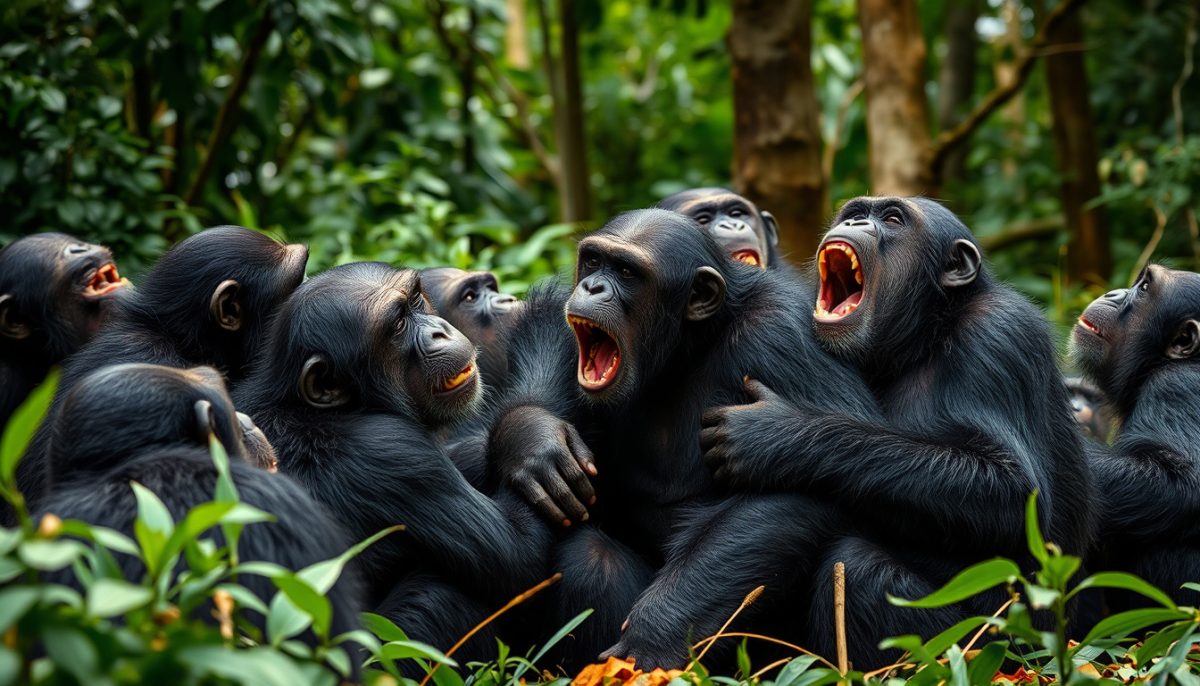
Unpacking Chimpanzee Violence Behavior: Insights into Aggression in Our Primate Relatives
The jungle is alive with a cacophony of sounds, each call echoing stories of survival, kinship, and sometimes, fierce conflict.
In the dense forests of Uganda, where the canopy is thick and the shadows dance, lives our closest relative—the chimpanzee.
Their world is one of complex social relations, filled with both tenderness and raw aggression.
Exploring the depths of chimpanzee violence behavior reveals not only their challenges but sheds light on the spectrum of emotions that define these remarkable primates.
As we embark on this journey through their intricate lives, we unravel the layers of violence that arise within these communities, compelling us to reflect upon our own human nature in the process.
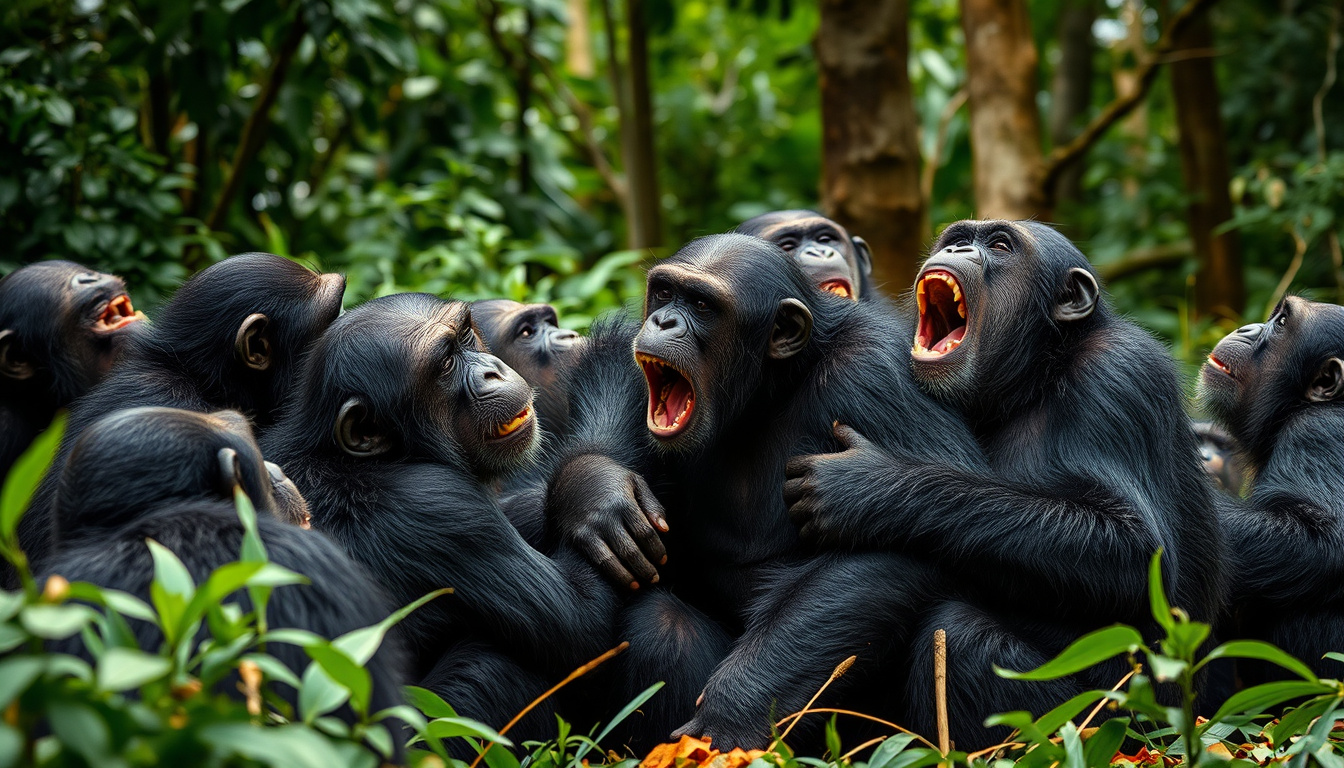
Key Takeaways
- Chimpanzee social structures heavily influence their aggression and violence behavior.
- Aggression plays a crucial role in establishing dominance and resources within chimpanzee communities.
- Factors such as food scarcity, competition, and social dynamics can trigger violent behavior in chimpanzees.
- Comparing chimpanzee aggression to human behavior provides insights into the evolutionary roots of violence.
- Understanding chimpanzee violence behavior can inform conservation efforts and improve human societal dynamics.
Understanding Chimpanzee Social Structures
Chimpanzee violence behavior is a complex and often misunderstood aspect of these remarkable primates’ social structures.
In the lush jungles of Uganda, where the vibrations of life echo around every corner, chimpanzees display both astonishing intellect and an unsettling propensity for aggression.
Understanding their social dynamics is crucial for comprehending how these behaviors manifest.
Chimpanzee societies are typically matrilineal, meaning that familial relationships play a significant role in their interactions.
Male chimpanzees are often seen asserting dominance in their groups, engaging in aggressive displays not just to establish hierarchy, but also to protect their families and resources.
This can lead to violence, whether in the form of territorial disputes or conflicts over mating rights.
For instance, researchers have observed coalitions form among males seeking to overpower rival groups, leading to coordinated attacks.
Interestingly, these violent encounters can also reinforce social bonds within the group, as individuals rely on each other for support in confrontational scenarios.
Contrary to popular belief, such aggressive behavior is not merely driven by a primal instinct but is also influenced by environmental pressures, scarcity of resources, and even learned behaviors.
Studies on chimpanzees in the wild suggest that their capacity for empathy and collaboration coexists with violent tendencies, highlighting the duality of their nature.
Moreover, observing these behaviors in their natural habitat offers vital insights into not only chimpanzee society but also our own evolutionary lineage, as the social structures and conflict resolution strategies of chimpanzees parallel certain human behaviors.
For those intrigued by the depth of chimpanzee social interactions and their violent behavior, a visit to Uganda offers an unparalleled opportunity to witness these dynamics firsthand.
The Role of Aggression in Chimpanzee Communities
In the heart of Uganda’s lush forests, a complex tapestry of social dynamics unfolds, revealing the intricate and often aggressive behavior of chimpanzees.
When discussing chimpanzee violence behavior, it’s essential to recognize that aggression is not merely a tool of destruction; it’s embedded in their survival, social structure, and evolutionary history.
Chimpanzees are known for their intricate familial ties, exhibiting both nurturing and violent traits, which can be best understood through the lens of their social hierarchies.
Aggression among chimpanzees manifests in various forms, from playful sparring between young males to serious disputes over territory between rival groups.
The context of these behaviors is vital.
For instance, in an environment where resources such as food and mates are limited, aggressive interactions can determine who survives and thrives.
This survival imperative leads to a natural selection process in which higher-ranking individuals commonly engage in displays of aggression to maintain their status, often reinforcing their position within the community.
Moreover, the social bonding that occurs post-conflict is equally significant.
After aggressive encounters, chimpanzees often partake in grooming rituals, which serve to rebuild social ties and mitigate tensions within the group.
This behavior highlights a unique aspect of chimpanzee interaction—while violence plays a role in their communities, so does the capacity for reconciliation and cooperative behavior.
Understanding these dynamics is crucial for anyone looking to experience these fascinating creatures in their natural habitat.
It’s a reminder of the volatile yet affectionate nature of their communities, making witnessing such interactions a unique aspect of chimpanzee tracking adventures in Uganda.
‘The greatness of a nation and its moral progress can be judged by the way its animals are treated.’ – Mahatma Gandhi
Factors Triggering Violent Behavior in Chimpanzees
Chimpanzee violence behavior is a captivating yet unsettling aspect of these fascinating primates.
Often characterized as our closest living relatives, chimpanzees display a complex social structure marked by both cooperation and conflict.
Understanding the triggers behind violent behavior in chimpanzees reveals insights into their natural instincts and social dynamics.
One of the primary factors contributing to these aggressive outbursts is competition over resources; food scarcity or mating opportunities can incite fierce rivalries within groups.
Additionally, the presence of an outsider or a rival troop can escalate tensions, leading to violent confrontations as individuals protect their territories.
Interestingly, social hierarchy plays a significant role as well.
Alpha males often engage in aggressive behaviors to maintain dominance, while lower-ranking individuals may turn to violence as a means of gaining respect or improving their social status.
Moreover, environmental stressors, such as habitat destruction, can exacerbate frustrations, leading to increased aggression.
By studying these behaviors, researchers not only gain a deeper understanding of chimpanzee society but also reflect on the evolutionary roots of aggression within our own species.
Comparing Chimpanzee Violence to Human Aggression
Chimpanzee violence behavior offers a fascinating lens through which we can explore the intricacies of aggression not just in the animal kingdom but also within our own human context.
Just like humans, chimpanzees are capable of forming complex hierarchies, and their communities can exhibit both social bonding and outright hostility.
In the wild, chimpanzees engage in aggressive encounters for various reasons, including territorial disputes, mating rights, and social dominance.
Such displays often involve physical confrontations, where strong individuals may assert their power over weaker members.
Interestingly, studies show that these violent behaviors have a primal foundation, similar to those seen in human conflict.
For instance, while human aggression can stem from socio-political factors or personal grievances, chimpanzee violence frequently emerges from instinctual drives to protect resources or establish status.
This similarity raises thought-provoking questions about the evolutionary basis of aggression; are we simply sophisticated versions of our primate relatives, shaped by similar biological imperatives?
While human societies tend to impose legal and moral frameworks to mitigate violence, chimpanzees operate within the raw dynamics of nature, where physical strength often dictates social standing.
Yet, it’s essential to recognize that both species exhibit nurturing aspects as well, suggesting that violence is just one part of a much more complex behavioral spectrum.
Understanding these nuanced layers of chimpanzee violence behavior illuminates not only their world but also our own, encouraging us to reflect on the nature of aggression and our social constructs around it.
Implications of Chimpanzee Violence Behavior for Conservation
Chimpanzees, our closest living relatives, exhibit a spectrum of behaviors that can be as fascinating as they are alarming.
One of the most significant yet often overlooked aspects of their social structure is chimpanzee violence behavior.
Observations in the wild show that these primates can engage in aggressive acts, not only towards one another but also against other species, including humans.
This behavior raises critical implications for conservation efforts.
Understanding the motivations for such violence—whether it stems from competition for resources, mating privileges, or territory—can provide valuable insights into chimpanzee social dynamics.
It becomes crucial to assess how these behaviors influence their survival and the overall health of ecosystem where they reside.
For instance, protection strategies need to account for the potential for violence among the chimpanzees, particularly in regions where human encroachment leads to increased competition.
Furthermore, the manifestation of violence can vary significantly based on environmental stressors.
Areas experiencing habitat destruction or depletion of vital resources may witness a rise in aggression among chimpanzee populations.
Thus, conservation strategies must not only focus on protecting these apes but also on ensuring their habitat is preserved and restored, fostering a balanced ecosystem that mitigates conflict.
In Uganda, engaging with these complex social behaviors in controlled settings, such as during chimpanzee tracking tours, can offer valuable educational opportunities.
These experiences cultivate a deeper understanding of primate behavior, illustrating the delicate balance necessary for conservation success.
By experiencing these behaviors firsthand and learning about them, visitors contribute to a greater awareness that drives support for ongoing conservation efforts.
Frequently Asked Questions
What are the main factors that trigger violent behavior in chimpanzees?
Factors triggering violent behavior in chimpanzees include competition for resources, mate selection, social hierarchy disputes, and responses to threats from other groups or within their community.
How does chimpanzee violence behavior compare to human aggression?
Chimpanzee violence behavior often reflects similar underlying motivations as human aggression, such as competition and territorial disputes, although human conflict also involves more complex social and cultural factors.
What role does aggression play in chimpanzee communities?
Aggression in chimpanzee communities can play a role in establishing dominance, maintaining social order, and protecting group members.
It can also result in bonding and alliances among group members when managed in certain social contexts.
What implications does understanding chimpanzee violence behavior have for conservation efforts?
Understanding chimpanzee violence behavior can inform conservation strategies by highlighting the need for stable group dynamics and resource availability, which are crucial for promoting peaceful coexistence and reducing conflict within chimpanzee populations.
How can insights from chimpanzee studies be applied to human society?
Insights from chimpanzee studies can help us understand the evolutionary roots of human aggression and social behavior, providing perspectives on conflict resolution, social hierarchy, and group dynamics in human communities.
If this story sparked your curiosity, you can experience it firsthand.
Bushman Safaris offers curated chimpanzee tracking experiences in Uganda, including access to Kibale National Park and the Ngogo region where these remarkable behaviors have been observed.
For our top 3 recommended Uganda chimpanzee tours, simply text “chimpanzee” to info@bushmansafaris.com
or WhatsApp +256 704 902398, and we’ll send you tailored options based on your travel preferences.