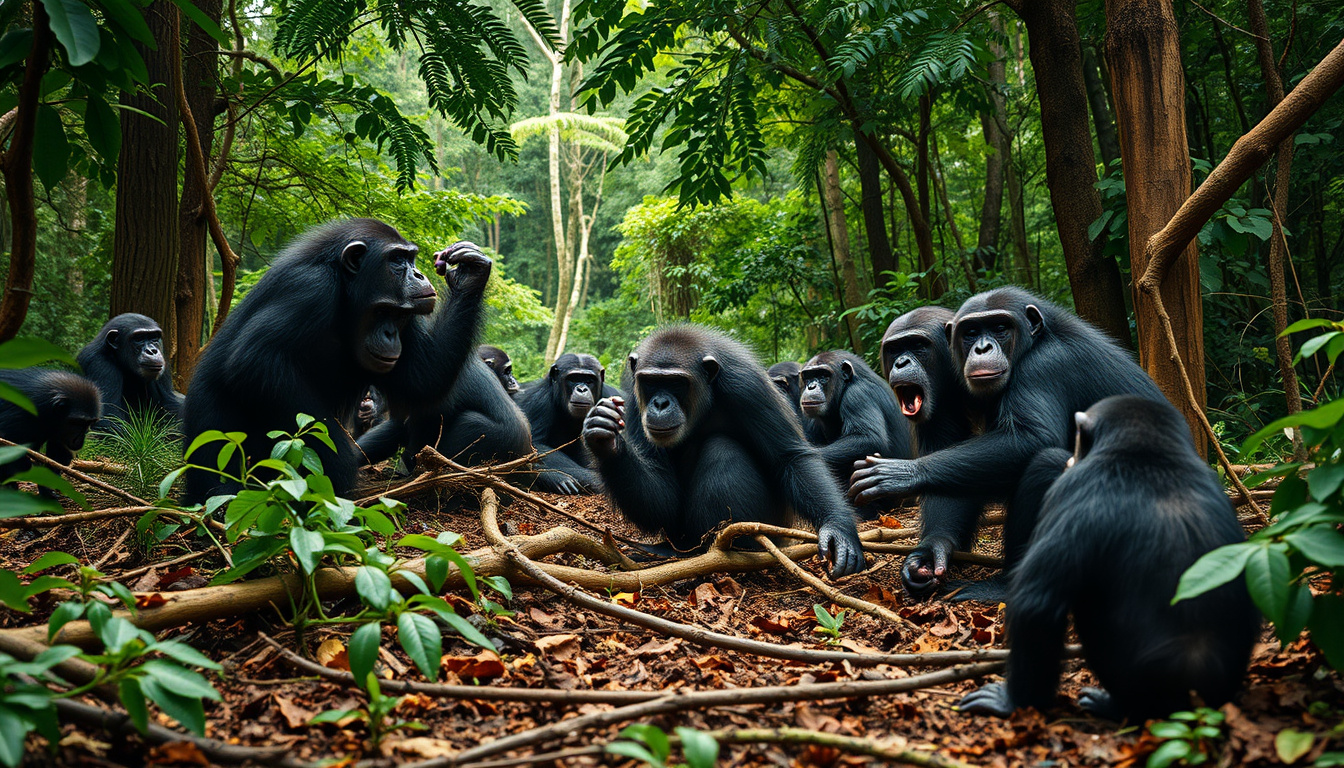


# Unveiling the Ngogo Chimpanzee Conflict: Location, Causes, and Implications
In the verdant forests of Uganda, where sunlight filters through dense canopies, a gripping drama unfolds—an intricate tale of survival, kinship, and conflict among our closest relatives.
The Ngogo chimpanzee conflict, a captivating saga that has drawn researchers and wildlife enthusiasts alike, takes place in the lush Kibale National Park.
Here, in this sanctuary of biodiversity, relationships among chimpanzee groups become fraught with tension, leading to clashes that can alter social dynamics, survival rates, and even the very structure of their communities.
But what exactly ignited this fierce struggle, where did this conflict transpire, and how does it continue to shape both the lives of these remarkable primates and the ecological landscape around them?
Join us as we delve deep into the heart of the Ngogo chimpanzee conflict, uncovering its location, causes, and far-reaching implications.

Key Takeaways
- The Ngogo Chimpanzee Conflict occurred in the Ngogo region of Uganda.
- Underlying causes of the conflict include competition for resources and social dynamics among chimpanzee groups.
- Behavioral implications include changes in social structures and increased aggression among chimpanzees.
- Ecologically, the conflict can disrupt local ecosystems and impact species diversity.
- Conservation efforts aim to mitigate conflict and promote chimpanzee welfare in the region.
Introduction to the Ngogo Chimpanzee Conflict
The Ngogo Chimpanzee Conflict is a fascinating case study that has captivated researchers and wildlife enthusiasts alike, taking place in the lush, expansive forests of Uganda’s Ngogo region, within the Kibale National Park.
This conflict primarily revolves around a dramatically escalating social struggle between different communities of chimpanzees.
It has offered invaluable insights into the complexities of primate behavior, including aggression, territoriality, and social structures, shedding light on what appears to be an ongoing fight for dominance and scarce resources in the wild.
By examining this rich tapestry of social dynamics, we can better understand not only the behavior of these remarkable creatures but also the broader implications for wildlife conservation and natural habitat preservation.
Geographic Location of the Conflict
# Where Did the Ngogo Chimpanzee Conflict Happen?
Amid the lush green expanse of Uganda’s Kibale National Park, there transpired a captivating yet stark narrative in the world of primate behaviour known as the Ngogo chimpanzee conflict.
This particular conflict unfolded within the Ngogo community, one of the largest and most researched groups of wild chimpanzees globally.
Spanning an impressive 35 square kilometers, the Ngogo range is perched in the heart of Kibale, which is renowned not just for its biodiversity but also for its dense forests and intricate ecosystems.
The Ngogo chimpanzees, in their natural habitat, exemplify complex social structures and behaviours that often mimic human-like interactions, providing an ideal stage for observing intergroup tensions.
Kibale National Park itself is strategically located in western Uganda, adjoining the Rwenzori Mountains and rich with a variety of flora and fauna.
Home to over 1,500 chimpanzees, the park represents a critical conservation area, making the Ngogo chimpanzee conflict a significant case study in understanding primate social dynamics and the anthropogenic factors influencing these interactions.
‘In the midst of chaos, there is also opportunity.’ – Sun Tzu

Key Causes of the Conflict among Chimpanzee Groups
## Key Causes of the Conflict among Chimpanzee Groups
Understanding the complexities of chimpanzee social dynamics can unravel the intricacies behind where did the Ngogo chimpanzee conflict happen.
This notable conflict occurred within the Ngogo community of chimpanzees in Uganda’s Kibale National Park, known for harboring the largest population of these primates in the world.
At the heart of this tension are several key causes: territorial disputes, competition for resources, and social hierarchies.
### Territorial Disputes
Chimpanzees are inherently territorial animals.
The Ngogo community, which boasts a large number of members, faces challenges as its boundaries overlap with neighboring communities.
This leads to confrontations, particularly when groups encroach on each other’s territory during foraging or in search of potential mates.
Such territorial skirmishes can escalate quickly and often result in aggressive encounters.
### Resource Competition
Another driving factor behind the Ngogo chimpanzee conflict is the competition for food resources.
Kibale National Park is rich in biodiversity, but the availability of fruits, insects, and other food sources can fluctuate dramatically depending on the seasons.
During periods of scarcity, tensions rise, and conflicts become more frequent as chimpanzee groups vie for limited resources.
### Social Hierarchies
Within the Ngogo community, complex social hierarchies influence behavior and interactions.
Dominance hierarchies play a critical role, as higher-ranking males often initiate and lead aggressive encounters to assert their status.
These power dynamics can incite conflicts, especially if subordinate males seek to challenge the established order or if females show preference for mates outside their own community.
In summary, the Ngogo chimpanzee conflict is a multifaceted phenomenon driven by territoriality, resource scarcity, and social hierarchies.
Understanding these underlying causes not only sheds light on the behaviors of our primate relatives but also raises awareness about the need for conservation efforts to protect their habitats and promote peaceful coexistence.
Behavioral Implications of the Conflict
### Behavioral Implications of the Conflict
In the heart of Uganda’s Kibale National Park, a significant chapter in the story of the Ngogo chimpanzee community unfolded, captivating researchers and wildlife enthusiasts alike.
The Ngogo chimpanzee conflict, primarily centered in this lush rainforest region, showcases the complexity of primate social structures and the behavioral implications that accompany such conflicts.
Studying where did the Ngogo chimpanzee conflict happen allows us to gain insights into the nuances of competition, territorial disputes, and group dynamics.
This conflict arose from increasing tensions over resources, including food and territory, as different chimpanzee groups encroached upon the Ngogo community’s domain.
Within the Ngogo clan, the leaders exhibited aggressive behaviors, asserting dominance to maintain their hierarchical structure.
Such aggressive interactions, leading to physical confrontations, not only altered the social landscape of the group but also provided a unique window into the evolutionary underpinnings of conflict resolution among chimpanzees.
As the conflict intensified, researchers observed a shift in social bonds, with some individuals forming alliances while others became isolated.
This fracturing mirrors human societal behaviors during conflicts, amplifying our understanding of how communal pressures can lead to both cooperation and competition.
Furthermore, post-conflict behaviors, such as grooming and reconciliatory gestures among the chimpanzees, highlight the importance of social cohesion after disputes.
By understanding where did the Ngogo chimpanzee conflict happen and the implications of these behaviors, we can appreciate the delicate balance of social structures not just in chimpanzees, but across species, including our own.

Ecological Consequences of the Ngogo Chimpanzee Conflict
## Ecological Consequences of the Ngogo Chimpanzee Conflict
In the lush forests of Uganda, nestled within the bounds of Kibale National Park, a remarkable but troubling episode unfolded — the Ngogo chimpanzee conflict.
This conflict, situated in the verdant expanse of central Africa, primarily took place among the Ngogo community of wild chimpanzees, which are known for their unique social structures and behavior.
As tensions escalated among different chimpanzee groups, the ecological repercussions became apparent, altering not just the dynamics within the community but also impacting the surrounding tropical environment.
The backdrop of this conflict is significant; Kibale National Park is one of the richest ecosystems in the world, housing a diverse range of both flora and fauna.
However, as the Ngogo chimpanzees engaged in territorial disputes, their actions resulted in alterations to the habitat that directly affected other species.
For instance, the aggressive behaviors and territorial expansion of the Ngogo group led to increased fruit tree depletion as these primates expanded their range in pursuit of food and dominance.
Moreover, with higher levels of aggression, chimpanzees spent less time foraging peacefully and more time competing with neighboring groups.
This shift in behavior not only threatened their own survival—a result of resource depletion—but also disrupted the delicate balance of the ecosystem in which they live.
As their feeding patterns shifted, countless other species, including birds and insects that rely on the same resources, faced difficulties in their own survival strategies.
This conflict serves as a poignant reminder of how anthropogenic activities and natural behaviors can intertwine to create lasting ecological consequences.
Understanding where the Ngogo chimpanzee conflict happened helps illuminate the broader implications for conservation efforts, as well as the need for ongoing research and monitoring of this vital ecosystem.
Conservation Efforts and Future Outlook
## Conservation Efforts and Future Outlook
The Ngogo chimpanzees, located in the Kibale National Park of Uganda, are at the heart of significant conservation discussions following the latest conflict that arose among their populations.
This conflict, which occurred in an area known as Ngogo, has highlighted the challenges and complexities involved in primate conservation efforts, particularly in regions where human activity intersects with wildlife habitats.
The Ngogo area has become a focal point for studying chimpanzee behavior and social dynamics, particularly in terms of territorial disputes.
Conservationists have noted that understanding these conflicts not only aids in protecting the species but also provides insights into the evolution of social structures among great apes.
As such, ongoing research in this region aims to establish a cohesive conservation plan that balances ecological preservation with the needs of local communities.
In response to the conflict, various organizations have ramped up efforts to promote awareness and engage local populations in conservation practices.
These initiatives focus on minimizing habitat destruction, providing education on the importance of gender diversity within chimpanzee populations, and fostering coexistence strategies between humans and chimpanzees.
Furthermore, the promotion of eco-tourism, particularly through structured experiences like those offered by Bushman Safaris, has been a critical component in generating funds for these conservation initiatives.
Looking ahead, the future of Ngogo chimpanzees will depend significantly on these collaborative conservation efforts.
Engaging with tourists who venture to observe these extraordinary creatures can lead to increased funding for research and protection while enhancing the local economy.
This mutual benefit not only aids in the survival of the Ngogo chimpanzee population but also cultivates a broader understanding of their intricate social lives.
Want to experience this unique setting in the wild?
You can request our top chimpanzee tracking experiences in Uganda by messaging ‘chimpanzee’ to info@bushmansafaris.com or +256 704
902398.
Frequently Asked Questions
What is the Ngogo Chimpanzee Conflict?
The Ngogo Chimpanzee Conflict refers to the territorial and social disputes occurring among chimpanzee groups in the Ngogo region of Uganda, primarily involving competition for resources, mating opportunities, and dominance.
Where did the Ngogo Chimpanzee Conflict occur?
The conflict took place in the Ngogo area of Kibale National Park in Uganda, a region known for its rich biodiversity and large population of wild chimpanzees.
What are the main causes of the Ngogo Chimpanzee Conflict?
The key causes of the conflict include competition for food resources, territorial disputes, mating rights among male chimpanzees, and social hierarchy dynamics within and between different chimpanzee communities.
What behavioral implications does the Ngogo Chimpanzee Conflict have?
The conflict can lead to increased aggression, altered social structures, changes in grooming patterns, and modifications in foraging behavior among the competing chimpanzee groups.
What conservation efforts are in place for the Ngogo chimpanzees?
Conservation efforts include habitat protection, research initiatives to monitor chimpanzee behavior, promoting ecotourism, and local community engagement to reduce human-wildlife conflict in the area.
If this story sparked your curiosity, you can experience it firsthand.
Bushman Safaris offers curated chimpanzee tracking experiences in Uganda, including access to Kibale National Park and the Ngogo region where these remarkable behaviors have been observed.
For our top 3 recommended Uganda chimpanzee tours, simply text “chimpanzee” to info@bushmansafaris.com
or WhatsApp +256 704 902398, and we’ll send you tailored options based on your travel preferences.