

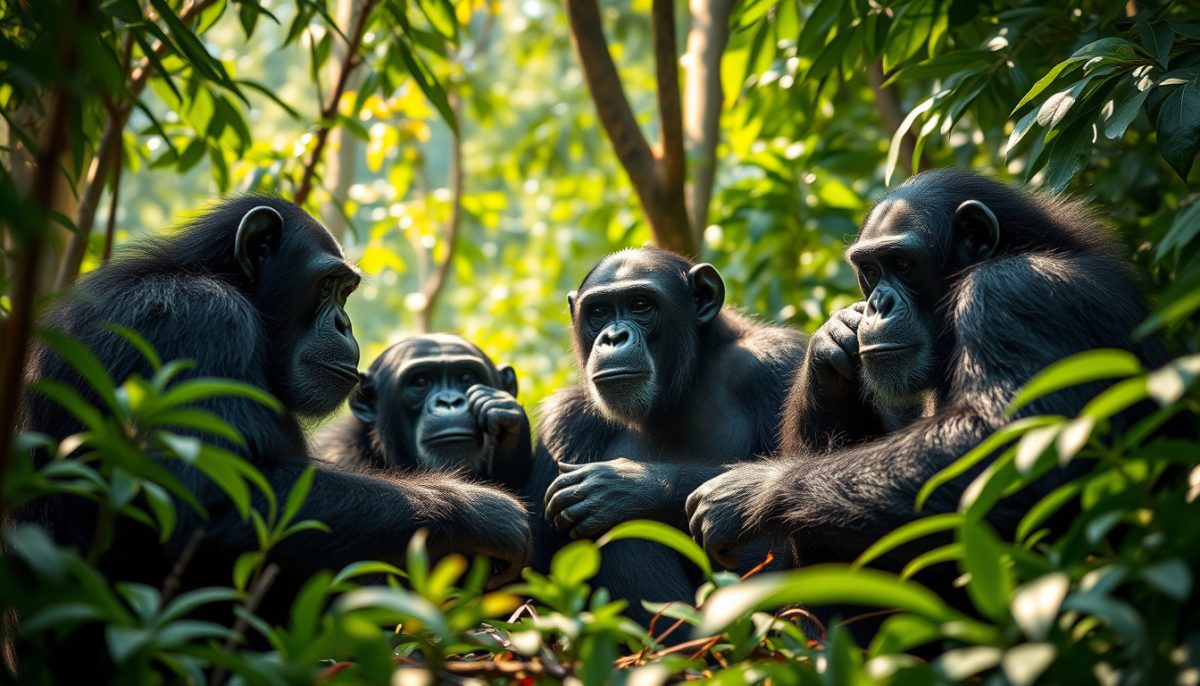
In the heart of the dense Ugandan rainforest, where the towering trees cradle the secrets of nature, an intricate drama unfolds.
Beneath the lush emerald canopy, chimpanzees engage in complex social interactions that reveal a side rarely visible to the untrained eye.
But what truly sets these remarkable primates apart is their capacity to organize attacks, a behavior steeped in strategy and intelligence.
As we delve deeper into the world of these fascinating creatures, we explore the question: how do chimpanzees organize attacks in the wild?
Through intricate social structures, sophisticated communication, and psychological underpinnings, chimpanzees navigate their forests with a social acumen that can rival our own.
Join us on this captivating journey into their world, where aggression, strategy, and survival converge.
Key Takeaways
- Chimpanzee social structures are complex and play a crucial role in their attack strategies.
- Aggressive behavior in chimpanzees can be influenced by social dynamics and environmental factors.
- Communication among chimpanzees is vital for the coordination and success of their attacks.
- Strategic planning involves assessing risk and opportunity when deciding to engage in aggressive encounters.
- Understanding chimpanzee attack behavior has important implications for their conservation and the preservation of their natural habitats.
Introduction to Chimpanzee Social Structure
### Introduction to Chimpanzee Social Structure
In the dense jungles of Uganda, where lush foliage meets the calls of the wild, the complex tapestry of chimpanzee society unfolds.
But how do chimpanzees organize attacks against their rivals?
This intriguing question leads us deep into the heart of their social structures and behaviors.
Unlike the chaotic confrontations often depicted in popular media, chimpanzee aggression is rooted in a sophisticated social hierarchy characterized by alliances, power dynamics, and intricate relationships.
At the foundation of this social structure lies a clear dominance hierarchy, with alpha males taking the lead, while coalitions of individuals collaborate to fend off intruders or assert territorial claims.
Understanding these dynamics not only highlights the advanced intellect of our primate relatives but also presents a compelling case for how we, as humans, can learn from their strategies in conflict resolution.
This article will explore the fascinating world of chimpanzee organization, drawing parallels to our own social behaviors and offering insights that can enrich our experiences observing these remarkable creatures in their natural habitat.
Understanding Aggressive Behavior in Chimpanzees
# How Do Chimpanzees Organize Attacks?
In the heart of Uganda’s pristine forests, a profound world thrives, where the daily dramas of chimpanzee life unfold with all the intensity of a wildlife documentary.
Here, within the verdant canopies, the echoes of primal roars reverberate, painting a vivid picture of social complexity and instinctual survival.
As you witness these remarkable creatures from a safe distance, you may find yourself pondering: how do chimpanzees organize attacks?
The answer lies in their intricate social structures and behaviors—an astonishing blend of intellect, emotion, and instinct.
## Overview
Chimpanzees, the closest living relatives to humans, share about 98% of our DNA, which offers us a unique lens through which to explore their social dynamics.
These primates live in communities that can vary from 20 to over 100 individuals, each with its own hierarchies and social relationships.
Their aggressive behaviors, often observed in the form of group attacks on other chimpanzees or species, are driven by several factors, including social status, territory, mating rights, and resource control.
In the lush forests of Uganda, where both food and safety are at a premium, understanding the mechanisms behind these attacks reveals much about their survival strategies.
## Deep Dive
### Social Hierarchies and Leadership
In chimpanzee societies, every troop has a dominant male, typically referred to as the alpha male.
This individual commands respect and, sometimes, fear among the group.
The alpha’s influence is pivotal in organizing group activities, including aggressive encounters.
Young males may challenge the alpha for status, and should they succeed, this shift in hierarchy often transforms group dynamics, including how collective attacks are organized.
Coordinated aggression isn’t random; it’s typically governed by social relationships, with allies supporting the alpha through complex buddy systems.
### Communication and Strategy
Chimpanzees possess a rich palette of vocalizations, gestures, and facial expressions that facilitate intricate communication.
Before an organized attack, these primates engage in specific calls known as pant hoots, which serve to rally others and synchronize their movements.
Research has shown that successful attacks often occur when larger groups coordinate their efforts effectively.
Hence, the gathering of individuals for an attack isn’t merely a spontaneous occurrence; it’s a deliberate decision often preceded by thorough assessment and planning.
## Key Insights
### Comparison with Human Behavior
Chimpanzee aggression mirrors some aspects of human conflict.
Just like humans, chimpanzees engage in coalitions, where alliances can shift, friends can become foes, and conflicts can be initiated over shared interests or perceived threats.
The evolution of violent behaviors in chimps provides insights into the biological and social roots of aggression.
### Cooperative Hunting and Attacking
Interestingly, while chimpanzees exhibit fierce aggression, they also demonstrate remarkable cooperation when hunting for food or defending territory.
This duality of behavior reflects a sophisticated balance between competition and collaboration that is not dissimilar to certain human societies.
The organizing principle?
Social cohesion and a shared goal, whether it’s acquiring a mate or protecting their young.
## Practical / Experiential Layer
For those adventurous souls seeking to witness these fascinating dynamics firsthand, Uganda offers unique opportunities for primate tracking, especially in Kibale National Park and Bwindi Impenetrable Forest.
Imagine the thrill of watching a group of chimpanzees from a safe distance as they orchestrate their daily lives, potentially engaging in social displays of both cooperation and aggression.
Want to experience this in the wild?
You can request our top chimpanzee tracking experiences in Uganda by messaging “chimpanzee” to info@bushmansafaris.com or +256 704
902398.
For a peaceful retreat after your jungle adventures, consider the Igwara Lodge, a boutique stay option nestled in nature, perfect for unwinding after a day filled with exploration.
The lodge offers an ideal base for travelers seeking a premium experience amid the stunning Ugandan landscape, where the cool breeze and serene environment serve as a stark contrast to the untamed energy of the chimpanzees.
## Conclusion
Understanding how chimpanzees organize attacks unveils the complexities of their social interactions.
These remarkable creatures not only reflect the primal instincts rooted deep within all mammals but also resonate with the intricate social behaviors we see in human societies.
As we continue to study our primate cousins, we gain invaluable insights into both our evolution and the fragility of the ecosystems we share with them.
Next time you find yourself in Uganda, consider embarking on this incredible journey of discovery, framed by the raw beauty of the land and the compelling stories of its wild inhabitants.
To discover the unrivaled experiences that await you, request the top 3 curated Uganda chimpanzee tours by texting “chimpanzee” to info@bushmansafaris.com or +256 704 902398 (WhatsApp).
‘The greatest danger in times of turbulence is not the turbulence; it is to act with yesterday’s logic.’ – Peter Drucker

The Role of Communication in Coordinating Attacks
## The Role of Communication in Coordinating Attacks
Chimpanzees exhibit a fascinating complexity in their social structures and behaviors, particularly when it comes to coordinating attacks.
Much like humans, they rely heavily on a sophisticated communication system that enables them to share information and unite in strategic efforts.
When a group of chimpanzees decides to mount an attack—whether against a rival troop or for hunting—their success depends largely on their ability to convey intentions and rally support amongst each other.
This communication is multifaceted, incorporating vocalizations, gestures, and even facial expressions.
Vocal calls, such as pant-hoots, serve to signal the presence of food or alert others to danger.
In the context of an impending attack, these calls are charged with urgency and purpose, minimizing ambiguity and ensuring that every member of the group understands the stakes involved.
Gestural communication such as pointing or grooming can also play a critical role, helping to direct attention towards specific targets or coordinate movements in preparation for an assault.
Research has indicated that the effectiveness of these communications can be influenced by factors such as social bonds among chimps, which fosters a sense of group cohesion.
Those with stronger relationships tend to have more synchronized group responses during attacks.
In essence, the role of communication goes beyond mere vocalizations; it is a vital component of chimpanzee social dynamics.
This ability to collaborate through coordinated calls and gestures not only enhances their chances of a successful outcome during attacks but also reflects a deep-rooted level of intelligence and emotional interconnectedness within their communities.
Strategic Planning: Factors Influencing Attack Decisions
# Understanding How Do Chimpanzees Organize Attacks: A Look into Strategic Planning
## Strategic Planning: Factors Influencing Attack Decisions
In the dense jungles and vibrant landscapes of Uganda, our closest relatives in the animal kingdom demonstrate behaviors that blur the lines between instinct and strategy, particularly when it comes to organizing attacks.
How do chimpanzees organize attacks? This intriguing question leads us into an exploration of their social dynamics, cognitive abilities, and the ecological pressures that shape their aggressive interactions.
Chimpanzees, known for their intelligence and complex social structures, utilize strategic planning in a variety of contexts, particularly in territorial disputes and resource acquisition.
Their decision-making processes are influenced by several crucial factors:
###
1.
Social Hierarchies and Alliances
Chimpanzees live in communities where social hierarchies play a pivotal role.
Males often engage in power struggles to establish dominance, and these social standings can dictate their likelihood of leading or participating in an attack.
Higher-ranking males usually have more allies and therefore may efficiently mobilize a group for an aggressive encounter.
Alliances between individuals can also influence attack strategies.
Chimpanzees form bonds and friendships that serve as a support network during conflicts.
These bonds often influence the decision to initiate an attack, where a group with strong alliances are more likely to coordinate, while isolated individuals may be more cautious.
###
2.
Environmental Factors
The ecological context significantly impacts how chimpanzees choose to organize attacks.
Factors such as resource availability, the presence of rival groups, and habitat structure can spur aggression.
For instance, when food resources are scarce, chimpanzees might be more inclined to raid neighboring territories, which necessitates strategic planning to ensure success.
The layout of their environment, including access to escape routes and cover, can determine the chosen strategies for both offensive and defensive actions.
###
3.
Cognitive Abilities and Learning
Chimpanzees possess advanced cognitive skills that enable them to remember past encounters, assess risks, and predict the responses of rival groups.
Previous experiences shape their understanding of the potential outcomes of an attack, allowing them to craft more nuanced tactics.
Research has shown that when faced with conflicts, chimpanzees can assess the strengths and weaknesses of other groups, adjusting their strategies accordingly.
This cognitive flexibility is akin to how humans might plan a military strategy, illustrating their deep understanding of social dynamics.
###
4.
Communication and Coordination
Effective communication is crucial for organizing attacks among chimpanzees.
They employ a range of vocalizations, gestures, and facial expressions to convey intentions and rally support from other members of their community.
This coordination can often determine the success of an attack, as chimps must synchronize their actions and maintain group cohesion throughout the ordeal.
In summary, the factors influencing how chimpanzees organize attacks are deeply intertwined with social structures, environmental contexts, cognitive abilities, and communication strategies.
As they traverse the complexities of their lives in the wild, understanding their approach to conflict offers profound insights into the evolutionary parallels between humans and these remarkable primates.

Case Studies: Documented Attacks in the Wild
## Case Studies: Documented Attacks in the Wild
Chimpanzees, our closest living relatives, possess complex social structures that often influence their behavior, including how they organize attacks on other groups.
Understanding how do chimpanzees organize attacks involves delving into both their instinctual behaviors and strategic thinking.
One documented case occurred in the Mahale Mountains National Park in Tanzania, where a chimpanzee group, known as the East Group, displayed impressive coordination during a raid on a neighboring group.
Researchers observed individuals taking up positions to flank the rival group’s members, showcasing a remarkable degree of planning.
The males, often the primary aggressors, used vocalizations and gestures to signal one another, creating a unit that exploited natural terrain for advantage.
In another instance, the Ngogo community in Kibale National Park, Uganda, executed a coordinated assault against a neighboring community that lasted over three years.
Observations revealed that the males would systematically patrol the boundaries of their territory while strategically ambushing their rivals at known crossing points, indicating a calculated approach to expanding their territory rather than merely responding to provocation.
These case studies illustrate that chimpanzees do not rely solely on instinct—there’s an evolving sophistication in how do chimpanzees organize attacks, utilizing both social bonds and cognitive strategies to achieve their competitive social goals.
The implications of these behaviors extend to understanding not only chimpanzees as a species but also the roots of human aggression and social strategy.
Conservation Implications of Understanding Chimpanzee Behavior
## Conservation Implications of Understanding Chimpanzee Behavior
Understanding how chimpanzees organize attacks provides crucial insights not only into their social structures but also into the broader conservation efforts necessary for their survival.
In the wild, chimpanzees often engage in coordinated attacks, usually on neighboring groups, a behavior that reflects their complex social hierarchies and communication skills.
By studying these patterns, conservationists can identify the environmental and social pressures that contribute to aggression among chimpanzee populations.
This knowledge is essential for developing effective conservation strategies that address habitat destruction, which can exacerbate conflicts between groups.
Additionally, understanding this behavior illuminates the importance of preserving their territories and resources.
When chimpanzees feel their kinship group is threatened, it often leads to organized defense strategies, revealing their need for stable populations to reduce violence among groups.
Only by recognizing these dynamics can conservation programs provide the support necessary to foster peaceful coexistence within chimpanzee communities.
In turn, this contributes to the overall biodiversity and ecological balance of their habitats, highlighting the interdependence of species and the ecosystems they inhabit.
Frequently Asked Questions
How do chimpanzees organize attacks in the wild?
Chimpanzees organize attacks through a combination of social structure, communication, and strategic planning.
They utilize their social hierarchies to form coalitions and communicate intentions through vocalizations, gestures, and facial expressions to coordinate their actions.
What factors influence chimpanzee attack decisions?
Factors influencing chimpanzee attack decisions include social relationships, resource availability, and the presence of rivals.
Environmental context and previous experiences also play a crucial role in determining when and how they decide to engage in aggressive behaviors.
What is the significance of communication in chimpanzee attacks?
Communication is vital for chimpanzees to coordinate their attacks effectively.
Through various forms of communication, such as calling out, signaling, and body language, they can rally their group members and ensure everyone is aligned before initiating an attack.
Can you provide examples of documented chimpanzee attacks?
Yes, there are several case studies that document chimpanzee attacks in the wild.
These include inter-group conflicts over territory and food resources, as well as organized group attacks against other chimpanzee communities, demonstrating their ability to plan and execute complex strategies.
How does understanding chimpanzee attack behavior contribute to conservation efforts?
Understanding how chimpanzees organize attacks can provide valuable insights into their social structures and behaviors, which can inform conservation strategies.
This knowledge helps in creating better protected environments and management plans that cater to their natural behaviors and community dynamics.
If this story sparked your curiosity, you can experience it firsthand.
Bushman Safaris offers curated chimpanzee tracking experiences in Uganda, including access to Kibale National Park and the Ngogo region where these remarkable behaviors have been observed.
For our top 3 recommended Uganda chimpanzee tours, simply text “chimpanzee” to info@bushmansafaris.com
or WhatsApp +256 704 902398, and we’ll send you tailored options based on your travel preferences.